
Childhood Screening For Refractive Errors And Squints
Singapore has one of the highest rates for myopia (short sightedness) in the world. A sad fact is that many of our young children of school-going age are already myopic, or have some other refractive error such as astigmatism (cylinder) or hyperopia (long-sightedness).


Myopia in children is more likely if one or more parent has it, and if the child reads 3 or more storybooks a week, as was found in a Singapore study. If your child has a myopic degree that is increasing at an alarming rate, it is best to see an eye specialist for an assessment.
Atropine is a prescription eyedrop that has been shown to reduce or stop the rate of myopic increase. Atropine acts in the eye to dilate the pupil and also temporarily relaxes the muscle that does the near focusing. It is thought that this has an effect on reducing myopia progression. The common problems with atropine eyedrop usage include sensitivity to bright lights, and the need to wear bifocal glasses for near work. Atropine is usually prescribed as a nightly eyedrop, but may be reduced to weekly administration on a Friday evening (to minimize impact on schoolwork) to reduce the occurrence of side-effects, with minimal loss of effectiveness.
Myopia in children is more likely if one or more parent has it, and if the child reads 3 or more storybooks a week, as was found in a Singapore study. If your child has a myopic degree that is increasing at an alarming rate, it is best to see an eye specialist for an assessment.
Atropine is a prescription eyedrop that has been shown to reduce or stop the rate of myopic increase. Atropine acts in the eye to dilate the pupil and also temporarily relaxes the muscle that does the near focusing. It is thought that this has an effect on reducing myopia progression. The common problems with atropine eyedrop usage include sensitivity to bright lights, and the need to wear bifocal glasses for near work. Atropine is usually prescribed as a nightly eyedrop, but may be reduced to weekly administration on a Friday evening (to minimize impact on schoolwork) to reduce the occurrence of side-effects, with minimal loss of effectiveness.
Squints (also called strabismus), or misaligned eyes are not too uncommon a problem. Common squints involve one or both eyes turning either inwards (convergent squint) or outwards (divergent squint), especially if the child is not concentrating at the time. Sometimes, this may be associated with an eye drifting upwards. A squint may be a problem in itself, or may signal other problems with the eyes. It is best also for an assessment by the eye specialist.
If a squint needs to be corrected, strabismus surgery is usually a quick day-case surgery, and is very successful. This can be timed for the school holidays so that the child does not miss school. If a squint is left uncorrected, it may affect the child’s sense of stereovision and distance judgement, cause one or both eyes to be “lazy”, and will affect self-esteem because of cruel teasing in school.
If your child has a squint or an uncorrected refractive error, such as astigmatism or long-sightedness, early detection and intervention can prevent the occurrence of “lazy eye” (or amblyopia). Intervention has to be done generally before the age of about 7 years, because corrections after this age give much poorer results. An eye clinic consultation will establish the problem, and we will be able to suggest an appropriate method of treatment for your child.
During the assessment, your child’s eye alignment will be checked for a squint, vision will be measured, and a degree assessment made. If the child is cooperative enough, eye pressure measurement will be also performed. Pupil dilation using eyedrops will be done to thoroughly examine the retina. If required, drops to relax the muscles of focusing will be instilled to accurately measure the eyes’ power. This whole process is a very complete eye exam, and may take about 2-3 hours. So please be patient with us, as we want the best eye exam for your child. It is preferable not to bring along other children who are not being examined during that visit, as they tend to get restless during this time.
关于克里斯托弗·康博士
克里斯托弗·康医生专攻复杂白内障和前节重建手术,尤其擅长虹膜重建和无虹膜症手术。他的其他专长领域包括复杂晶状体手术、新型晶状体和超声乳化技术、屈光手术、有晶体眼人工晶状体(可植入胶原蛋白晶状体,ICL)以及小切口、局部麻醉超声乳化白内障手术。.
他在英国苏格兰阿伯丁大学完成了前两年的医学本科学习,并且两年都名列班级第一。由于费用问题,他最终在新加坡国立大学完成了内外全科医学士学位(MBBS)。.
康医生曾任新加坡国家眼科中心(SNEC)住院医师,后升任副顾问眼科医生。在SNEC工作结束后,康医生曾任新加坡陈笃生医院眼科研究所顾问。.
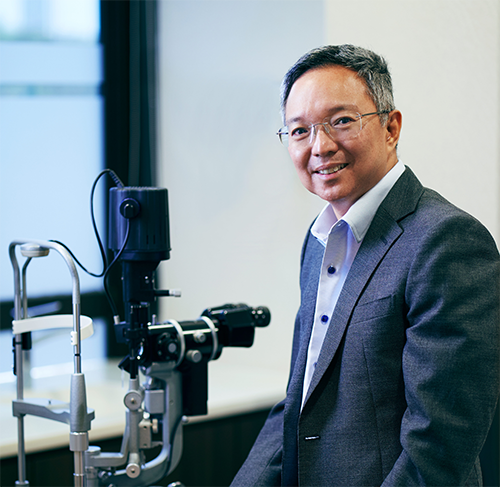
克里斯托弗·康博士
内外全科医学士、眼科医学硕士、爱丁堡皇家外科学院院士、眼科专科医师(2003年) 眼科顾问医师