
YAG Laser Treatment for Blurry Vision After Cataract Surgery
A safe and effective outpatient laser treatment for blurry vision after cataract surgery

Dr. Christopher Khng
- Medical Director, Cataract Surgery Specialist
- MBBS, M.Med(Ophth), FRCS(Edin), AMS(Ophth 2003)
Table of Contents
- Intro
- What Is YAG Laser Treatment?
- YAG Laser vs LASIK: Not the Same Thing
- What Is a Narrow Angle?
- The YAG Laser Procedure: Step by Step
- What to Expect and Recovery
- YAG Laser Treatment Cost in Singapore: Fees and MediSave Coverage
- YAG Laser Treatment at EyeWise Vision Clinic
- Frequently Asked Questions
- Restore Your Vision at EyeWise Vision
- Contact Us
If your vision has become cloudy, hazy or glare-sensitive in the months or years after cataract surgery, you are not experiencing a recurrence of your cataract.
What you are most likely experiencing is posterior capsule opacification (PCO), a common and treatable condition in which the thin membrane behind your intraocular lens gradually clouds over.
A quick, painless laser procedure called YAG laser capsulotomy can restore your visual acuity to what it was after your cataract surgery, usually within hours.
At EyeWise Vision, Dr Christopher Khng performs YAG laser capsulotomy and laser peripheral iridotomy (for narrow-angle glaucoma). The procedure is typically quick, non-invasive and is performed as an outpatient procedure.
What Is YAG Laser Treatment?
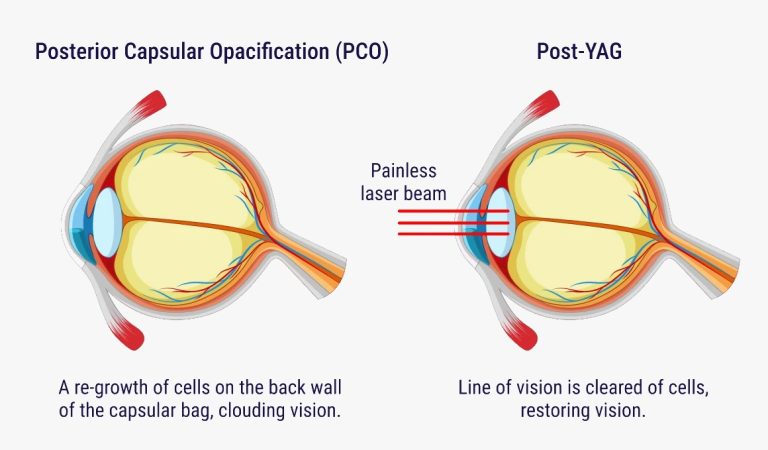
YAG laser treatment uses a Neodymium-doped YAG (Nd:YAG) laser — a precise and focused laser that delivers targeted energy pulses to specific eye structures without making any incision and without touching the eye surface. It is a non-invasive procedure performed at a laser machine while you are seated comfortably.
There are two distinct conditions treated by YAG laser at EyeWise Vision:
- YAG laser capsulotomy: to treat posterior capsule opacification (PCO) following cataract surgery
- YAG laser peripheral iridotomy (LPI): to treat or prevent narrow-angle glaucoma
The specialist leading your care
Our Cataract Surgeon

Dr Christopher Khng
Medical Director, Senior Consultant Ophthalmologist & Cataract SpecialistMBBS, M.Med(Ophth), FRCS(Edin), AMS(Ophth 2003)
Dr Christopher Khng is a Fellowship-Trained eye specialist based in Singapore, specialising in Cataract Surgery, utilising Bladeless techniques and advanced Lens Implants.
With over two decades of experience in complex cataract surgery and anterior segment reconstruction, Dr Khng manages advanced cataract cases requiring specialised surgical techniques.
His expertise covers iris repair and complex intraocular lens surgery procedures, often required when standard cataract surgery is insufficient.
Dr Khng graduated from the National University of Singapore (NUS), following his initial medical training at Aberdeen University in Scotland, where he received academic distinctions in medicine.
Built on extensive international training and clinical tenure, he is proficient in treating complicated cataract cases with minimal visual compromise, utilising established techniques and implant devices such as capsular tension rings, iris hooks and specialised sutures.
Dr Christopher Khng
Medical Director, Senior Consultant Ophthalmologist & Cataract SpecialistMBBS, M.Med(Ophth), FRCS(Edin), AMS(Ophth 2003)
YAG Laser vs LASIK: Not the Same Thing
| YAG Laser Treatment | Lasik | |
|---|---|---|
| What it treats | Cloudy lens capsule (PCO) or narrow angle (glaucoma) | Refractive errors: myopia, hyperopia, astigmatism |
| Where it acts | Inside the eye: posterior capsule or iris | Cornea: surface of the eye |
| Incisions | None — completely non-invasive | Corneal flap created |
| Who needs it | Post-cataract surgery patients; narrow-angle glaucoma patients | Patients seeking to reduce glasses or contact lens dependence |
| Recovery | Hours — return to normal activities same day | Days to weeks for corneal healing |
| Is it permanent? | Yes. PCO cannot recur after capsulotomy | Yes. Corneal reshaping is permanent |
Understanding Narrow Angles and Glaucoma Risk: How Laser Iridotomy Helps
The drainage angle of the eye — the channel through which aqueous fluid flows out of the anterior chamber — can be anatomically narrow in certain individuals. This is more common in Asian populations, including Singaporeans, than in Western populations, partly due to differences in eye anatomy.
A narrow angle raises the risk of acute angle-closure glaucoma: a sudden and painful spike in intraocular pressure that can cause permanent vision loss within hours if not treated.
Laser Peripheral Iridotomy (LPI): Preventive Treatment
YAG laser peripheral iridotomy (LPI) creates a tiny, microscopic opening in the peripheral iris using the Nd:YAG laser. This opening allows aqueous fluid to flow freely between the posterior and anterior chambers of the eye, equalising the pressure and preventing the angle from closing. The procedure is preventive and takes approximately 10 minutes per eye.
- No incision, no stitches. The laser creates the opening without touching the eye surface
- Performed under topical anaesthetic eye drops. No injections required
- Both eyes are typically treated to protect the fellow eye if narrow angles are bilateral
For a full overview of glaucoma risk and treatment options, visit our glaucoma treatment page.
The YAG Laser Procedure: Step by Step
1
Consultation and Diagnosis
2
Mydriatic Drops Applied
3
Topical Anaesthetic Drops
4
YAG Laser Treatment (under 5 minutes)
5
Post-Procedure Assessment
6
1-Month Follow-Up Review
What to Expect and Recovery
During the Procedure
- You will see brief, rapid flashes of light. Not painful — just momentarily bright
- No sensation of cutting or heat. The laser disruption occurs internally without you feeling anything
- Vision may appear slightly blurred immediately after due to dilating drops and floating debris from the disrupted capsule. This clears within a few hours
- Mild eye irritation may occur after the anaesthetic wears off. This is managed with prescribed anti-inflammatory drops
Recovery and Aftercare – Same Day, Zero Downtime
- Return to normal daily activities the same day
- Vision continues to improve over the following 24 to 48 hours as the debris from the disrupted capsule settles and clears
- Arrange transport for the day. Mydriatic drops will temporarily blur your vision and make you more light-sensitive for several hours; driving is not recommended on the day itself
- Use prescribed anti-inflammatory drops for the full one-week course as directed
- The results are permanent. Once the posterior capsule has been opened, PCO cannot recur. There is no need for repeat treatment
YAG Laser Treatment Cost in Singapore: Fees and MediSave Coverage
Disclaimer: Any fees or cost estimates are indicative, subject to change over time and may vary based on individual clinical needs and other factors.
| Cost Component | YAG Capsulotomy | Laser Peripheral Iridotomy |
|---|---|---|
| Surgeon fee (excl. GST) | SGD $1,100 to $1,800 | SGD $500 to $900 per eye |
| Typical total bill (private hospital, incl. GST) | ~SGD $1,490 to $2,219 | ~SGD $2,021 to $2,785 |
| MediSave claimable (approx.) | ~SGD $490 | ~SGD $1,120 |
| MOH TOSP code | SL815L, Table 1C | SL801I, Table 2C |

Insurance Coverage
- MediSave: YAG laser capsulotomy is claimable under TOSP code SL815L from your own CPF MediSave account, or a spouse’s or child’s account
- Integrated Shield Plans: AIA HealthShield, Prudential PRUShield, NTUC IncomeShield and Great Eastern SupremeHealth typically cover the balance above MediSave.
- Corporate insurance: Many employer-sponsored plans include coverage for ophthalmic procedures — check with your HR or insurer
- Claims assistance: Our team can help you navigate MediSave claims and insurance paperwork so you can focus on your recovery




YAG Laser Treatment at EyeWise Vision Clinic

Frequently asked questions
Patient information
About the Procedure
Is YAG laser the same as cataract surgery?
Is the YAG laser procedure painful?
How soon will my vision clear after YAG laser capsulotomy?
Can PCO come back after YAG laser treatment?
What is the recovery time for a YAG laser capsulotomy?
Can I drive home after the YAG laser procedure?
Risks and Side Effects
What are the risks and side effects of YAG laser capsulotomy?
What is the success rate of YAG laser capsulotomy?
Can YAG laser capsulotomy go wrong?
Cost and Eligibility
Is YAG laser capsulotomy covered by MediSave?
Is YAG laser capsulotomy safe and worth doing?
How many times can a YAG laser capsulotomy be done?
What percentage of people need a YAG after cataract surgery?
Do you need new glasses after a YAG laser capsulotomy?
Schedule a YAG Laser Consultation
Contact Us
Have concerns about your eye health or changes in your vision? Our team is here to help. Simply complete the form below, or reach us directly by phone (+65 6476 1211) or WhatsApp for assistance with your appointment.